Wednesday, September 11, 2013

Pot Shots, Mid-September

'Picasso' petunias

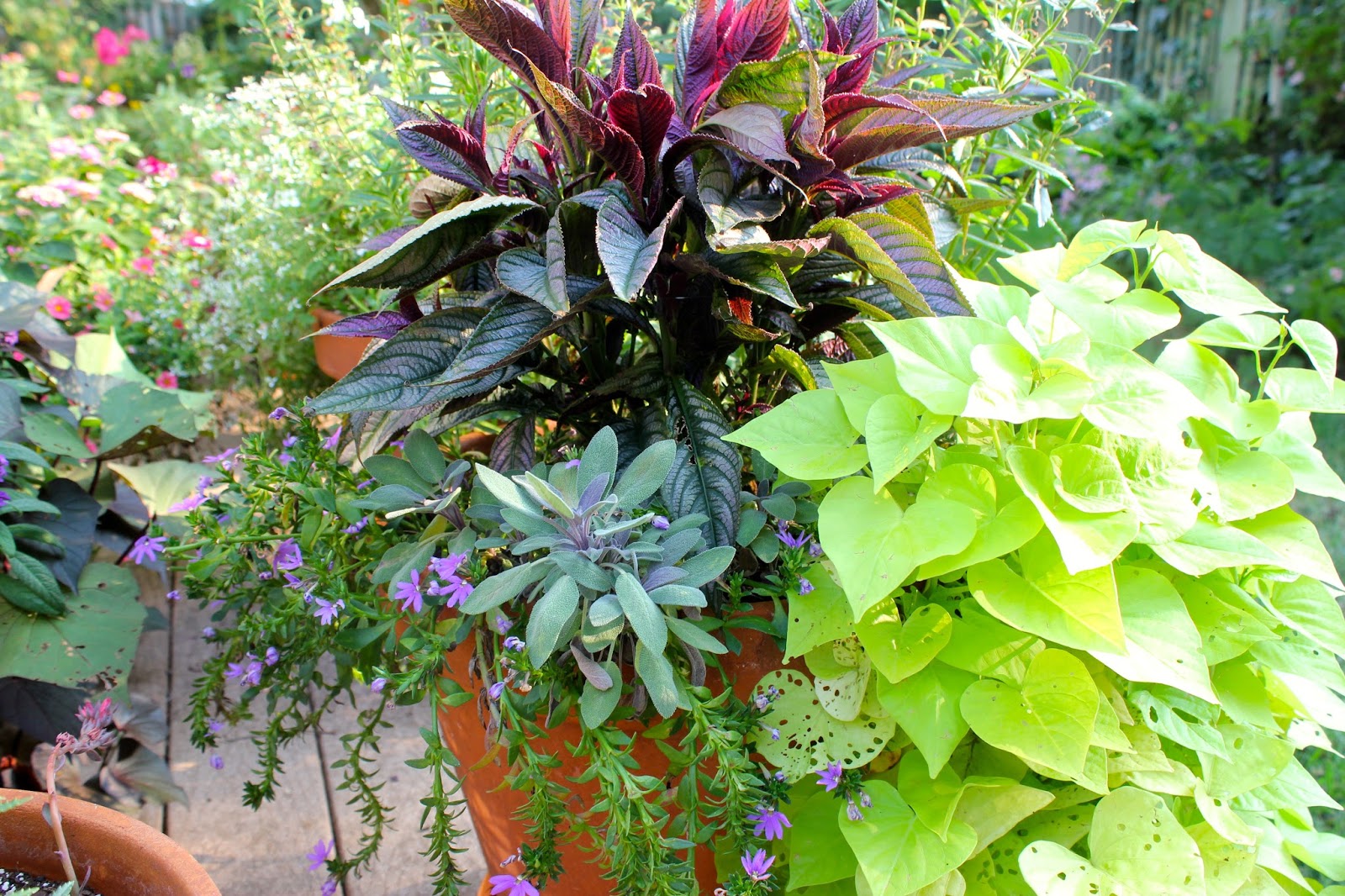
I went out this morning to take an inventory of my pots and see what is still looking good, four months after planting. The winners are angelonia, heliotrope, lantana (some), perilla, scaveola,  setcresea, begonias, and of course all the sweet potato vines. Some of the million bells are still hanging in, but looking a little straggly. Surprisingly, my vincas don't look that good, kind of yellowed and losing steam. They usually do great right up until frost. And I have been disappointed this year with the lantana, which is always a winner for me. Maybe I picked up the wrong varieties this year, but the ones I have in pots are tall and gangly, not very attractive in pots. It seems like the pink and purple varieties are doing well, but the other colors are not. Strange.

Angelonia, Perilla, Heliotrope, Sweet Potato Vine

Heliotrope, Sweet Potato Vine, Angelonia

Pink Lantana, Heliotrope, Sweet Potato Vine

Scarlet Vinca, Lantana, Million Bells

Scaveola, Setcresea, Sweet Potato Vine

Scaveola, Variegated Sage, Perilla, Sweet Potato Vine

Vinca, Lantana, Heliotrope, Angelonia

Perilla, Lavender Lantana

This pot of white vinca and euphorbia 'Diamond Frost' has never looked good. Why haven't I just pitched it?


I cut everything back in this pot a few weeks ago--pink scaveola, pink million bells, and some angelonia--but it hasn't really recovered. I think it was too many plants for the pot, as they never really flourished. Time to go. I also have a pot of 'Profusion' zinnias, which I couldn't even make myself take a picture of, they look so bad. They do awesome in the ground, but not so good in a pot (at least for me). I don't mind editing a little at this time of year...time for a few pots to go.


Tuesday, September 10, 2013

Green and White


My autumn clematis really popped this weekend~~ it is a huge mass of snowy, fragrant flowers. It's really kind of amazing how this plant grows. In April I thought it was dead--we had pruned it back to the ground--and look at it now. I get so annoyed with its rampant growth, but these flowers make it worthwhile...I think. All those white flowers look especially great in the evening. I have been thinking more about white flowers lately as I really like the whites and greens in the garden. I have been making a list of whites that I want to plant next year--white 'Sonata' cosmos, white zinnias, white cleome, and of course cimicifuga, or white bugbane, a perennial that I loved this summer in Vermont in my friend JoAnn's lovely garden.


Friday, September 6, 2013

Virgil's Bees, by Carol Ann Duffy


Virgil's Bees, by Carol Ann Duffy

Bless air's gift of sweetness, honey
from the bees, inspired by clover,
marigold, eucalyptus, thyme,
the hundred perfumes of the wind.
Bless the beekeeper

who chooses for her hives
a site near water, violet beds, no yew,
no echo. Let the light lilt, leak, green
or gold, pigment for queens,
and joy be inexplicable but there
in harmony of willowherb and stream,
of summer heat and breeze, 
each bee's body 
at its brilliant flower, lover-stunned,
strumming on fragrance, smitten.

For this,
let gardens grow, where beelines end,
sighing in roses, saffron blooms, buddleia;
where bees pray on their knees, sing, praise
in pear trees, plum trees; bees
are the batteries of orchards, gardens, guard them.


Thursday, September 5, 2013

Hillwood Estate and Gardens


The weather was so nice last weekend and so on Sunday we decided to go downtown to visit the Hillwood Estate and Gardens,  former home of Marjorie Merriweather Post, who was the heiress to the Post cereal fortune. Her estate is in northwest DC and overlooks Rock Creek Park. It's really an oasis in the middle of the city, with lots of gardens--a French parterre, a rose garden, a cutting garden, a Japanese style garden, and lots of woods, as well as the mansion and a greenhouse.  Mrs. Post lived there for over 20 years and decorated the house with French and Russian furnishings and fine arts. Several rooms in the house are devoted to her various collections, including lots of porcelain dishware and Russian Faberge eggs.

We really enjoyed touring the house--you could really imagine life in that house, unlike a lot of historical houses that I have visited.  It was fun to read about all the famous people who she entertained in her home. Mrs. Post died at Hillwood in 1973.


Rose garden
Cutting Garden

Greenhouse


Orchids


Love these ivy covered archways


And inside the house--the dining room was pretty impressive. The table can seat more than 30 people. The floors in the house were beautiful.


The kitchen was pretty amazing too, so well stocked with all the conveniences of a 1950s kitchen. I liked the green butler's pantry too.


This was just a small selection of her china collection. There were rooms filled with decorative objects like this.  She had all the cabinets custom built to showcase her collection.

French porcelain

I loved the view of the French parterre garden from an upstairs bedroom window.


All the French porcelain and Faberge eggs were nice, but the best collection was in Mrs. Post's closet--her favorite shoes!  She liked them so much  that she bought them in all colors. I like them too!


Tuesday, September 3, 2013

End of Summer


We had a beautiful Labor Day weekend here in Virginia.  I worked on Saturday but on Sunday we went into DC, visited a museum and its gardens,  and enjoyed a frozen margarita or two outside at Cactus Cantina downtown. We had some rain at night, I weeded the garden, I cut lots of zinnias, we grilled hot dogs on the grill, and we watched lots of MI-5 on Netflix. Summer ends...


Friday, August 30, 2013

Fall Berries


I'm kind of obssessed with the berries on my kousa dogwood (Cornus kousa) tree. The other day I was looking out my kitchen window and was astonished to see just how many berries there are and that almost all have turned red.  It really flowered profusely this spring, so I shouldn't be surprised at the berries. And it's like it happened overnight--well, not really, but it does seem like they turned red quickly. I looked up the fruit online and apparently the berries are edible--they make delicious wine and jam!  Who knew. The fruit is supposedly sweet and creamy, and the redder the berry and the more berries on the tree,  the sweeter the fruit.  Hmm, I guess I am going to have to try a few of those berries.


There are tons of berries on the back of the tree, too, that haven't turned red yet. Really, it's incredible how many berries there are. I have noticed that my kousa blooms well every other year. I can find no explanation for this, but it is like clockwork.  I am going to have to watch to see what happens next year.


And as evidence for this, here is a page from my garden journal for last summer--2012--No kousa flowers!


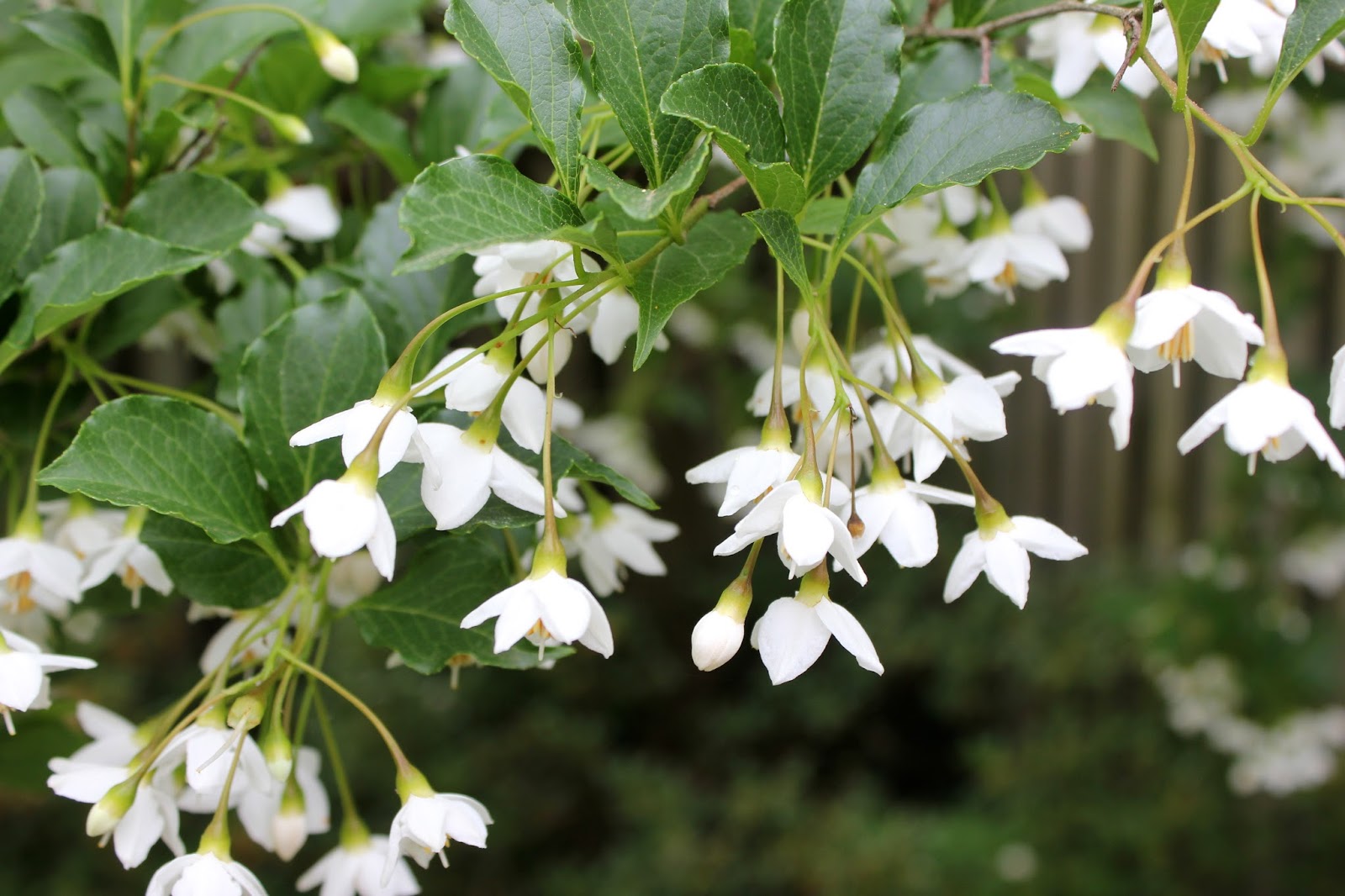
I also like the fruit on my Japanese snowbell tree (Styrax japonica). Not quite as showy, but still pretty. I love the creamy green color.


And here are two pictures of these trees from May, when they were in their blooming glory. You can see the immature berries in the flowers. These are both beautiful trees.

Kousa dogwood

Snowbell tree

Thursday, August 29, 2013

Canada


My library book group read Canada for a discussion last night and I was pleasantly surprised that so many people liked the book. I found it kind of slow moving, there's really not much of a plot as you learn most of what is going to happen in the book in the first sentences of the first chapter.  "First,  I'll tell about the robbery our parents committed. Then about the murders, which happened later." It is the story of 15-year-old Dell Parsons, whose parents make the unfortunate decision to rob a bank to pay off a debt, and are sent to prison, leaving Dell  and his twin sister Berner abandoned and alone, and the family torn apart forever.  After a few days on their own, Berner runs away to California, and Dell is taken by his mother’s friend across the border to Canada, where he lives for a short time in Saskatchewan province with some shady characters.   The book is divided into three parts--his life with his family in Great Falls, Montana, and when the robbery takes place, the short period when he lives in Saskatchewan, and 50 years later, when an older Dell is looking back on his life. I liked the first part the best and felt the second part was too long and slow.  The strength of the book is Dell's voice,  telling the story and describing the setting, and his feelings about a life gone astray and what happens next.

When I got to the end of the book, I thought the very last sentences pretty much summed up the book and how Dell made sense of his world.

“What I know is, you have a better chance in life—of surviving it—if you tolerate loss well;  manage not to be a cynic through it all; to subordinate, as Ruskin implied, to keep proportion, to connect the unequal things into a whole that preserves the good, even if admittedly good is often not simple to find. We try, as my sister said. We try. All of us. We try."

Wednesday, August 28, 2013

Obsessed With Wardian Cases

Image via Pinterest

One of these days I am going to get myself a Wardian Case. I keep browsing Pinterest and online, searching for just the perfect one. I would really like a freestanding one, like the one above, but maybe the tabletop ones are more practical?  I would love to plant mine with some ferns, mosses, and begonias. I can tell summer is coming to an end because I am getting interested in house plants again. My sister had an interesting ruffled fern at her house and now I may have to look for that...


Antique Wardian Case,  Image via Pinterest

Image via Pinterest

Image via Pinterest


Image via Pinterest

Image via Pottery Barn
The case below is one I always look for when we visit the U.S. Botanic Gardens in D.C.  They move it around and change it up periodically so you have to hunt for it. But I always find it and I always start thinking about Wardian cases again.